The I-864 is the US partner's promise to the government that their spouse won't need public benefits. USCIS calls it a legally enforceable contract (USCIS, Affidavit of Support). Almost every family green card needs one, and it's the form that worries couples most, because it comes down to income.
The I-864 at a glance
- Income needed: at least 125% of the poverty guideline. For a household of 2 in the lower 48 states that's $27,050 a year. Active duty military sponsoring a spouse use 100%: $21,640.
- USCIS filing fee: $0. If your case goes through the National Visa Center, the State Department charges $120 to review it.
- Form edition: USCIS only accepts the 08/24/26 edition from 1 Oct 2026. It includes a release for a consumer credit report (USCIS).
- Who signs: the petitioner, who must be 18 or older, a US citizen or green card holder, and living (domiciled) in the US (USCIS).
Free official form
- Form I-864 (PDF) et its instructions. Current edition: 08/24/26 (USCIS, Form I-864)
- Form I-864A, if a household member is adding their income
- No separate filing: it goes in with your partner's I-485, or to the National Visa Center if they're applying from abroad (USCIS). If the I-485 is filed online, the I-864 is uploaded with it
Official forms are free from USCIS. Sites that charge for them are charging for the convenience, not the form. Check the edition date at the bottom of each page before you send it: USCIS can reject an old edition.
Check Your Income
Pick your household size, then enter the sponsor's yearly income. Add a household member's income if someone will sign an I-864A. If you're short, it shows the assets you'd need to close the gap.
Sponsor income check
Pick your household size and where you live, then enter the sponsor's income.
Minimum for your household:
Ways to close the gap
- Assets worth at least : the gap. How assets count
- Add the income of a relative who lives with you, on Form I-864A
- Ask a joint sponsor who meets the rule on their own
2026 guidelines, in effect from 1 Mar 2026. Source: USCIS Form I-864P.
The full 2026 table for every household size, Alaska and Hawaii is on our income requirement page.
When You File It
| Route | When the I-864 goes in |
|---|---|
| CR-1 / IR-1 spouse visa et F2A | After the I-130 is approved, to the National Visa Center, with the review fee (State Department, Affidavit of Support). |
| K-1 fiancé visa | Not with the I-129F. It's filed with the green card application (I-485) after the wedding (USCIS). For the visa interview the embassy may ask for the I-134 instead: see I-134 vs I-864. |
| Marriage green card inside the US | With the I-485 (USCIS). |
What Counts Toward the Income
USCIS asks for the sponsor's federal tax return for the most recent year and proof of current employment or self-employment (USCIS). Your household size counts you, anyone you support, and your partner. The I-864P table sets the number for each size.
- Your own income, from the tax return and current pay.
- Household members, using Form I-864A. A relative by birth, marriage or adoption who lives with you or is a dependent on your tax return can add their income by signing an I-864A. They become responsible for the support too (USCIS).
- Assets. If income falls short, assets can make up the gap. Normally they need to be worth 5 times the shortfall. For the spouse of a US citizen it's 3 times (USCIS).
Documents to Send With It
From the USCIS filing checklist (USCIS, Form I-864, updated 4 Sep 2026):
- Every sponsor: your federal tax return for the most recent year, with W-2s, every 1099 and schedule. Or a statement explaining why you didn't have to file. You can add the last three years, six months of pay stubs and a letter from your employer if they help
- Self-employed: Schedule C, D, E or F from your latest return
- Using a household member's income: a separate I-864A from each person, their tax return, and proof they live with you and how they're related, unless they're a dependent on your return
- Using assets: documents showing where each asset is, who owns it, when it was acquired and what it's worth, plus any loans against it
- Joint sponsors: proof of US citizenship (birth certificate, passport or naturalization certificate) or both sides of the green card
- Active duty military using 100%: proof of active duty status
USCIS lists four fields it checks before accepting the form at a lockbox: the sponsor's family name, address, Social Security number and signature (USCIS). The 08/24/26 edition also lets USCIS ask credit reporting agencies about you. If you have a credit freeze, USCIS says to respond quickly to any request to lift it, or the case can be delayed.
Filling In the Form, Part by Part
Here are the parts of the form couples ask about most, from the official 08/24/26 edition. The highlights show where each answer goes, and the notes come from the USCIS instructions.
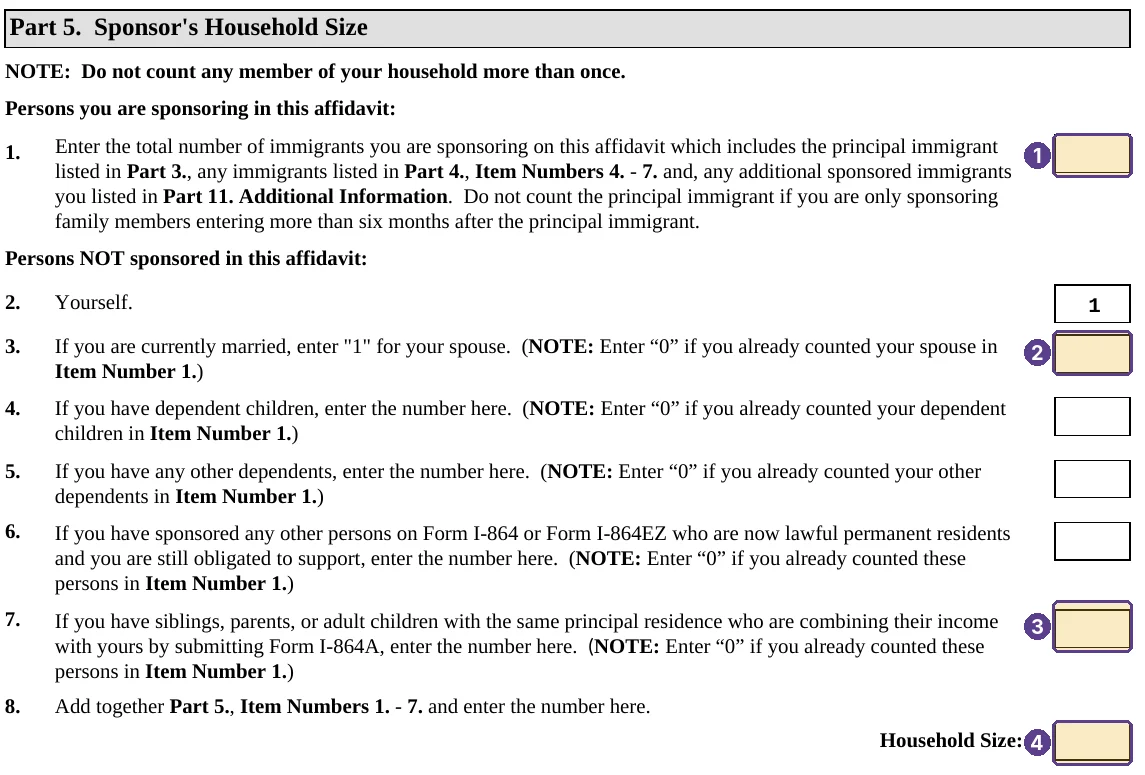
- Item 1: the people you're sponsoring on this form. Your partner goes here, plus any of their children coming with them.
- Item 3: enter 1 if you're married. If the person you're married to is the one you're sponsoring and you already counted them in item 1, enter 0 so they aren't counted twice.
- Item 7: only for a parent, brother, sister or adult child who lives with you and whose income you need. Each of them signs Form I-864A.
- Item 8: add items 1 to 7. That's your household size, the number you look up on the I-864P table (and the one the income checker above asks for). Items 4 to 6 cover your children under 21, anyone else on your tax return as a dependent, and anyone you've sponsored before and still support.
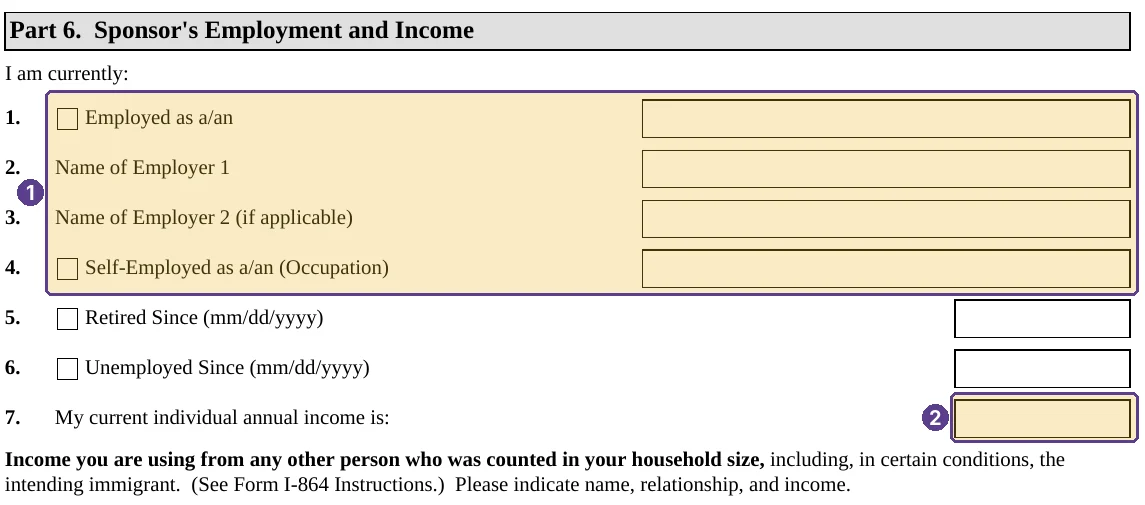
- Items 1 to 6: tick every box that applies to you (employed, self-employed, retired or unemployed) and fill in the details.
- Item 7: your own current yearly income from work or retirement. Means-tested public benefits can't be counted. The instructions say a recent letter from your employer or six months of pay stubs can back it up.
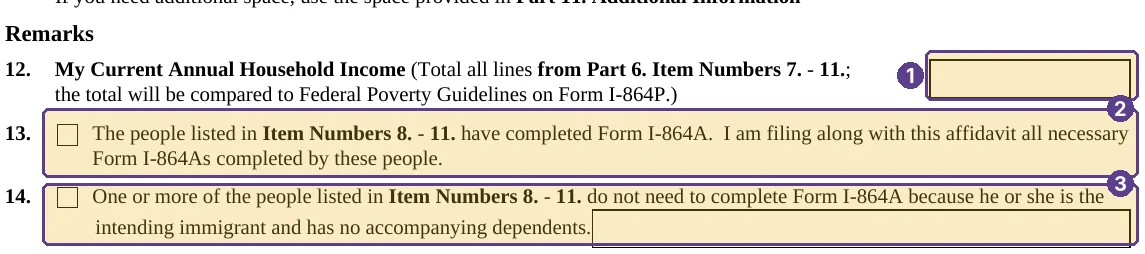
- Item 12: your income from item 7 plus everyone listed in items 8 to 11. This total is what USCIS compares with the poverty guideline for your household size.
- Item 13: tick this if everyone in items 8 to 11 has signed an I-864A, which goes in with this form.
- Item 14: tick this if someone listed doesn't need an I-864A because they're the immigrant and have no spouse or children coming with them. If you're counting your partner's own income, the instructions ask for evidence it will continue from the same source after they get the green card.
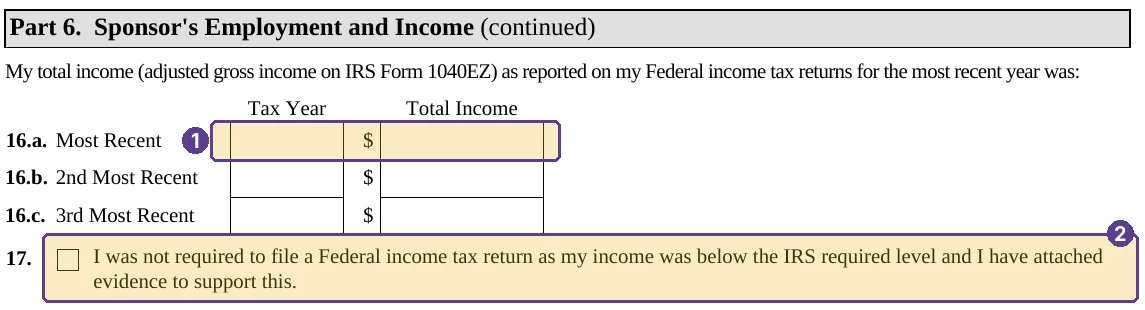
- Item 16.a: the most recent tax year and the total income from that return. The instructions say not to leave it blank: write zero if it was zero, or N/A if you didn't have to file. 16.b and 16.c are optional earlier years, and N/A if you're not sending them.
- Item 17: tick this if your income was under the IRS filing level, and attach a written explanation. The instructions point out that living outside the US doesn't exempt US citizens or green card holders from filing a federal return.
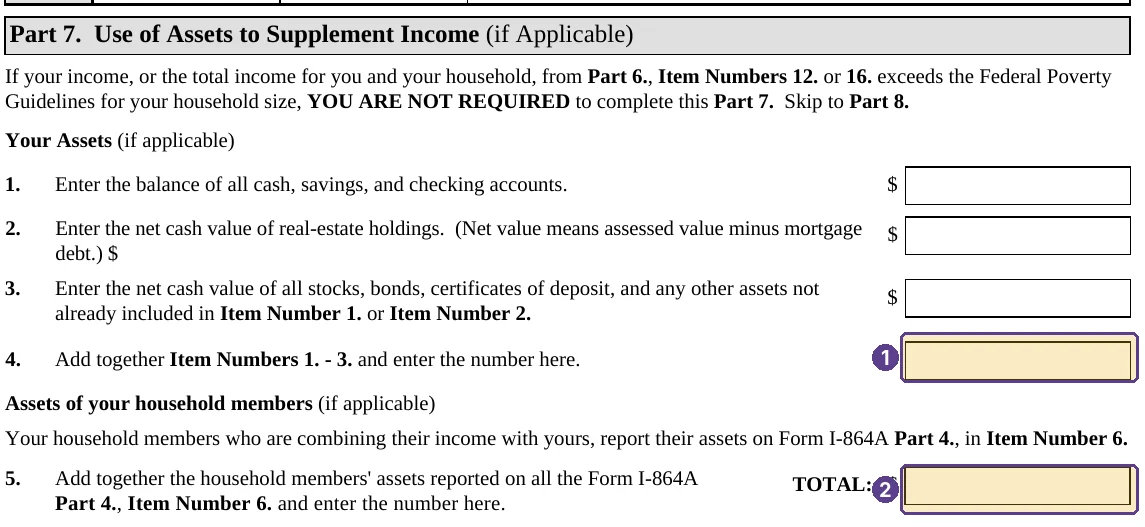
- Items 1 to 4: your savings, the net value of real estate and other assets like stocks, with item 4 as the total. Only assets that can become cash within a year count, and a car only counts if you have another one you're not listing. Each needs documents showing ownership and value.
- Item 5: assets of household members who signed an I-864A. Your partner's own assets go in items 6 to 9 on the next page, wherever they live.
Joint Sponsors
If you can't reach the line, someone else can sign a separate I-864 as a joint sponsor. They don't need to be related to you. They have to meet the same basic rules as you (18 or older, citizen or green card holder, living in the US), and they have to reach 125% for their own household on their own. Your income and theirs can't be added together (USCIS).
When the Promise Ends
Divorce doesn't end it. USCIS lists the events that do (USCIS, Affidavit of Support):
- Your partner becomes a US citizen
- Your partner has worked, or can be credited with, 40 quarters of work (usually 10 years)
- Your partner leaves the US and is no longer a permanent resident
- Your partner dies, or the sponsor dies (debts already owed still stand)
USCIS also reminds sponsors that if the person they sponsored gets means-tested public benefits, the agency that paid them can ask the sponsor to repay the cost, and can sue if they don't (USCIS, Form I-864).
Moving house while the promise is in force? The sponsor files Form I-865 within 30 days (USCIS).
Keep Talking About More Than Forms
Paperwork takes over a lot of calls. When you need a break from it, the deck has 150 questions for long distance couples, and they work just as well once you're in the same room.
4.97/5, loved by 1000s of couples
Feel the miles melt away, one question at a time
150 thought-provoking questions made for long distance couples.
Go deeper than “how was your day” and really get to know each other: the stories, the dreams, the little details.
En savoir plusMore form guides: NOA1, NOA2 and I-797, I-134 vs I-864, DS-260 checklist, Proof of relationship, I-751 guide, Medical exam (I-693), CEAC status and 221(g), I-130A guide, I-129F guide, K-1 after the wedding, K-1 vs CR-1 vs IR-1, Conditional vs 10-year green card, Citizenship through marriage, K-1 visa cost et Interview questions. Or start from the visas hub.
Questions Couples Ask
At least 125% of the poverty guideline for your household. That's $27,050 for a household of 2 in the lower 48 states, or $34,150 for 3. Alaska and Hawaii have higher figures.
No. USCIS says the obligation continues after divorce. It ends when your partner becomes a citizen, is credited with 40 quarters of work, leaves the US and gives up permanent residence, or dies.
The I-864 is the sponsor's own promise. The I-864A is signed by a household member, such as a relative living with you, who adds their income to yours and shares the responsibility.
No. A joint sponsor has to meet 125% for their own household on their own.
No. For K-1 couples it goes in with the green card application (I-485) after the wedding.
This isn't legal advice. We're a long distance couple, not lawyers. Every fact here comes from official pages, but your case may have details that change things. For advice on your situation, find an immigration lawyer through the AILA lawyer search.
Spotted Something Newer?
Rules and fees change, and couples going through it often notice first. If something here is out of date, or you've been charged a fee we haven't listed, let us know. We check every report against the official page before changing anything.
This isn't legal advice. We're a long distance couple, not lawyers. Every fact here comes from official pages, but your case may have details that change things. For advice on your situation, find an immigration lawyer through the AILA lawyer search.
Sources
- USCIS, Affidavit of Support, page updated 04 Sep 2026, checked 18 Nov 2026.
- USCIS, Form I-864, checked 18 Nov 2026.
- USCIS, Form I-864P poverty guidelines, in effect from 1 Mar 2026, checked 18 Nov 2026.
- USCIS, Form I-864A, checked 18 Nov 2026.
- USCIS, Form I-865, checked 18 Nov 2026.
- State Department, Affidavit of Support (immigrant visa step 4), checked 18 Nov 2026.
- USCIS, Form G-1055 Fee Schedule et State Department, Fees for Visa Services, checked 12 Nov 2026.

Transform your date nights
150 thought provoking questions and prompts designed for long distance couples.
Therapist approved, and made to play over video call or in person.
- Connect on a deeper, more intimate level
- Improve communication & understanding
- Learn something new each time you play
Loved by long distance couples
4.97
★★★★★
33 verified reviews
30-day guarantee
Hassle-free returns
Free US shipping
On orders $65+
Award winner
Announcement soon!
★★★★★
"The questions are intentional and thought provoking. I’m a psychotherapist and this one definitely has my stamp of approval."
★★★★★
"One card had us talking for an hour! Some of these questions got real emotional while others had us laughing!"
★★★★★
"The cards have helped us have every FT call be a deepening of our relationship. These cards have brought us closer and kept us close."
