Here's how much you need to earn under the 2026 I-864 poverty guidelines. To bring your spouse or fiancé(e) to the US, the US partner signs an Affidavit of Support (Form I-864), a promise to the government that they can support them. To qualify, the sponsor's household income has to be at least 125% of the US poverty guidelines for their household size, or 100% if they're on active duty in the US Armed Forces and sponsoring their spouse. The 2026 figures apply from 1 March 2026.
Couple, no kids
$27,050
Minimum yearly income for a household of 2 in the lower 48 states
Each extra person
+$7,100
Added for every person beyond 8, with bigger steps between 2 and 8
Check Your Income
Pick your household size and where you live, then enter the sponsor's yearly income. If you're short, it shows what it would take to close the gap.
Sponsor income check
Pick your household size and where you live, then enter the sponsor's income.
Minimum for your household:
Ways to close the gap
- Assets worth at least : the gap. How assets count
- Add the income of a relative who lives with you, on Form I-864A
- Ask a joint sponsor who meets the rule on their own
2026 guidelines, in effect from 1 Mar 2026. Source: USCIS Form I-864P.
2026 I-864P Poverty Guidelines (125%)
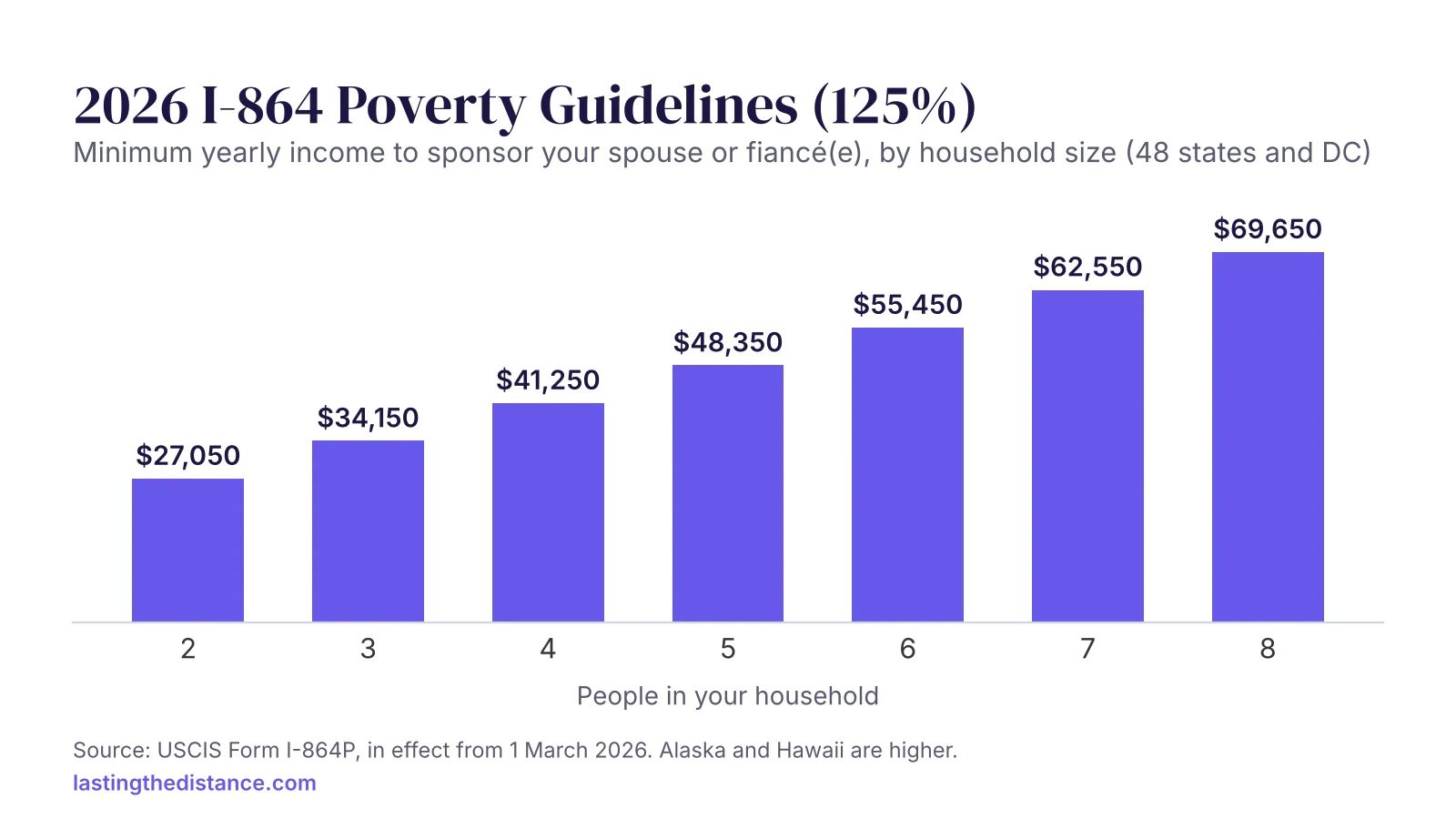
These are the 2026 I-864P poverty guidelines at 125%, the table most sponsors use, from USCIS Form I-864P (in effect from 1 March 2026). Find your household size and read across to where you live.
| Household size | 48 states, DC and territories | Alaska | Hawaii |
|---|---|---|---|
| 2 | $27,050 | $33,813 | $31,113 |
| 3 | $34,150 | $42,688 | $39,275 |
| 4 | $41,250 | $51,563 | $47,438 |
| 5 | $48,350 | $60,438 | $55,600 |
| 6 | $55,450 | $69,313 | $63,763 |
| 7 | $62,550 | $78,188 | $71,925 |
| 8 | $69,650 | $87,063 | $80,088 |
| Each extra person | +$7,100 | +$8,875 | +$8,163 |
Active duty in the US Armed Forces (100%)
If you're on active duty and sponsoring your spouse or child, you only need 100% of the guideline. This doesn't apply to joint sponsors.
| Household size | 48 states, DC and territories | Alaska | Hawaii |
|---|---|---|---|
| 2 | $21,640 | $27,050 | $24,890 |
| 3 | $27,320 | $34,150 | $31,420 |
| 4 | $33,000 | $41,250 | $37,950 |
| 5 | $38,680 | $48,350 | $44,480 |
| 6 | $44,360 | $55,450 | $51,010 |
| 7 | $50,040 | $62,550 | $57,540 |
| 8 | $55,720 | $69,650 | $64,070 |
| Each extra person | +$5,680 | +$7,100 | +$6,530 |
Source: USCIS, HHS Poverty Guidelines for Affidavit of Support (Form I-864P).
Who Counts in Your Household Size
Household size is where most people get the number wrong, and a bigger household means a higher minimum. USCIS says to count these people, no matter where they live:
- You, the sponsor
- Your spouse, if you already have one
- Your dependent children under 21
- Anyone else listed as a dependent on your most recent federal tax return
- Everyone you're sponsoring on this affidavit (your partner, plus any of their children coming with them)
- Anyone you sponsored before on an I-864 who you still have to support
You can also add an adult relative who lives with you (a parent, sibling or adult child) if you want to count their income. They sign Form I-864A. Count every person only once.
What Counts as Income
USCIS looks at your current yearly income and your most recent federal tax return. You can include your pay and things like alimony, child support, dividends or interest if you can show them. Means-tested public benefits don't count. Sources: USCIS Form I-864 and instructions.
What If You Don't Earn Enough?
Coming up short is common, and it doesn't end your case. There are three ways to close the gap, and you can combine them:
1. Use assets
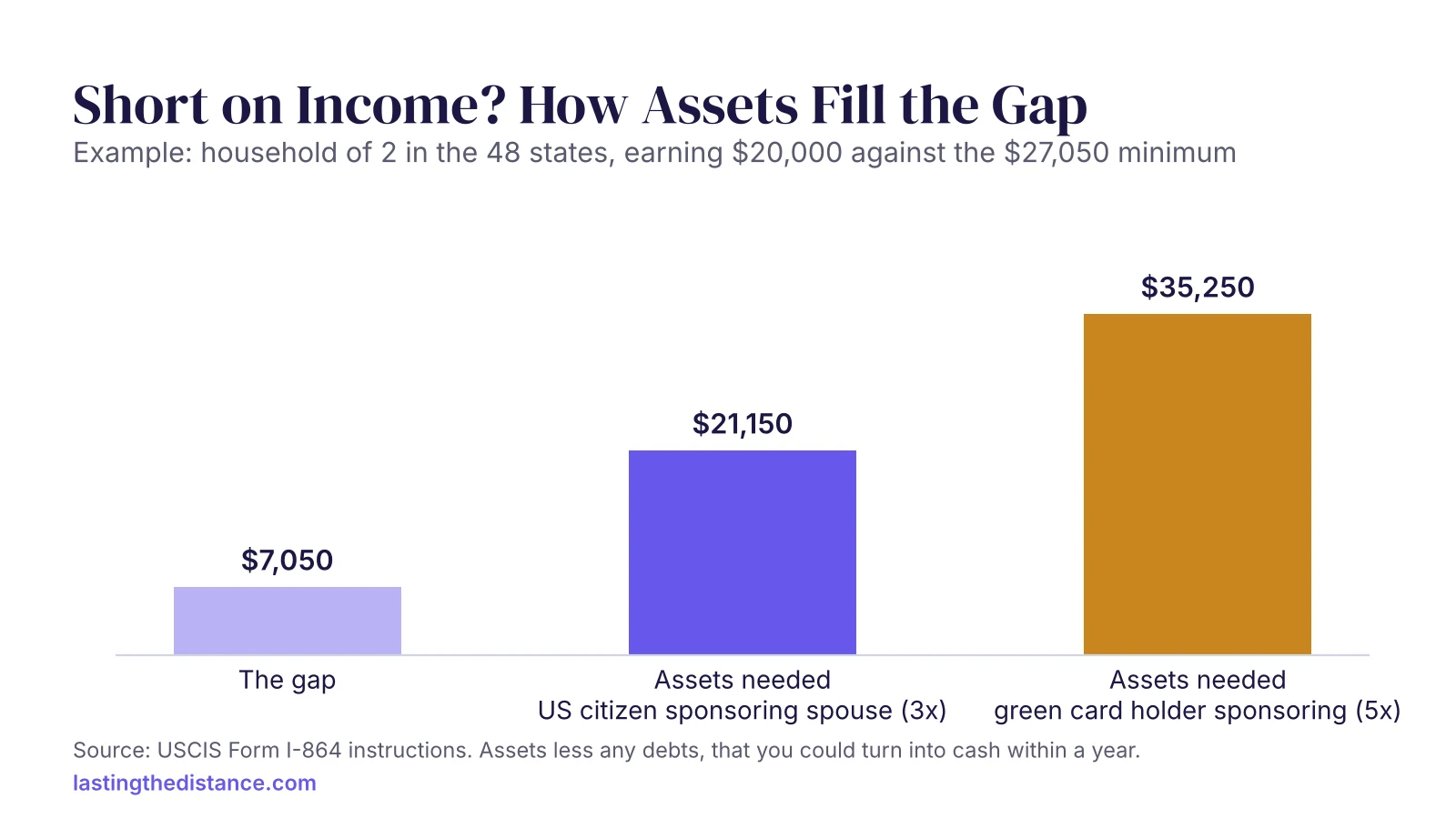
Your assets (less any debts against them) need to be worth 5 times the gap. If you're a US citizen sponsoring your spouse, it's only 3 times. Assets have to be things you could turn into cash within a year, like savings, stocks, bonds or property. You can count your home. You can't count your car unless you have more than one, and then only the extra ones. Source: State Department, I-864 FAQs.
2. Add a household member's income
A relative aged 18 or over who lives with you (or your spouse) can add their income by signing Form I-864A. They're counted in your household size and share the responsibility with you.
3. Find a joint sponsor
A joint sponsor files their own I-864 and has to meet the 125% rule on their own, for their own household plus the people they're sponsoring. They must be 18 or over, a US citizen, national or green card holder, and live in the US. You can have up to two joint sponsors per family, and you still sign your own I-864 as the petitioner.
How Long the Promise Lasts
The I-864 is a legally enforceable contract. It usually lasts until your partner becomes a US citizen or is credited with 40 quarters of work (usually about 10 years). It also ends if either of you dies, or if your partner gives up their green card and leaves the US. Divorce doesn't end it. Source: USCIS, Affidavit of Support.
K-1 Couples: When the I-864 Comes In
For the K-1 visa interview, the embassy may ask for evidence that you can support your fiancé(e). The I-864 itself comes later, with the green card application (Form I-485) after the wedding. The same income rule applies then.
Your Next Step
Each of our guides has this check built in, along with the fees, a timeline and the document checklist: K-1 fiancé visa, CR-1 spouse visa, F2A spouse visa (green card holders), Marriage green card (spouse already in the US).
Want to know what it all costs first? The visa cost calculator totals the fees for every route and splits them between you.
Questions Couples Ask
For a household of 2 (you and your spouse) in the lower 48 states, it's $27,050 a year, which is 125% of the 2026 poverty guideline. It's $33,813 in Alaska and $31,113 in Hawaii. Each extra person in your household raises it.
No. The promise lasts until your partner becomes a US citizen or is credited with 40 quarters of work, or one of you dies, or your partner gives up their green card and leaves the US. Divorce isn't on that list.
No. A joint sponsor files their own I-864 and meets the income rule on their own, so they don't need to live with you. They do need to live in the US.
This isn't legal advice. We're a long distance couple, not lawyers. Every fact here comes from official pages, but your case may have details that change things. For advice on your situation, find an immigration lawyer through the AILA lawyer search.
Spotted Something Newer?
Rules and fees change, and couples going through it often notice first. If something here is out of date, or you've been charged a fee we haven't listed, let us know. We check every report against the official page before changing anything.
This isn't legal advice. We're a long distance couple, not lawyers. Every fact here comes from official pages, but your case may have details that change things. For advice on your situation, find an immigration lawyer through the AILA lawyer search.
Sources
- USCIS, HHS Poverty Guidelines for Affidavit of Support (Form I-864P), in effect from 1 March 2026.
- USCIS, Form I-864 and instructions.
- USCIS, Affidavit of Support.
- State Department, I-864 Affidavit of Support FAQs.

Transform your date nights
150 thought provoking questions and prompts designed for long distance couples.
Therapist approved, and made to play over video call or in person.
- Connect on a deeper, more intimate level
- Improve communication & understanding
- Learn something new each time you play
Loved by long distance couples
4.97
★★★★★
33 verified reviews
30-day guarantee
Hassle-free returns
Free US shipping
On orders $65+
Award winner
Announcement soon!
★★★★★
"The questions are intentional and thought provoking. I’m a psychotherapist and this one definitely has my stamp of approval."
★★★★★
"One card had us talking for an hour! Some of these questions got real emotional while others had us laughing!"
★★★★★
"The cards have helped us have every FT call be a deepening of our relationship. These cards have brought us closer and kept us close."
