Already together in the US? Maybe your fiancé(e) arrived on a K-1 and you've just married, or your spouse is here lawfully on another visa. The marriage green card (adjustment of status) is how they become a permanent resident without leaving. Here's who can use it, how long it takes, what it costs and who pays what, then every document you'll need.
Fees and wait times change often. We keep an eye on them for you, and every number links to where it came from. Spotted something newer before we have? Let us know with the form at the end of the page.
New to all this? Whenever you see this button , clicktap it for a plain-English explanation and a link to the official page. Just like this. ClickTap it again to close it.
NAVIGATION RAPIDE
Step 1: Can You Apply From the US?
There are two common ways couples get here:
- After a K-1: your fiancé(e) entered on a K-1 and you married the US citizen who petitioned for them. No I-130 is needed: the approved I-129F is the basis. State Department, K-1 visa
- Spouse already in the US: you're married to a US citizen and your spouse is in the US lawfully. You can file the I-130 and I-485 together.
Either way, your spouse generally needs proof they were inspected and admitted or paroled into the US, such as their I-94 record.
Not sure where you stand? Answer a few quick questions and we'll point you to the right route.
Can you apply from the US?
Answer each question. Your result updates as you go.
Is your partner a US citizen, and are you married (or marrying within 90 days of a K-1 arrival)?
Is the spouse applying in the US right now?
Did they enter the US lawfully, inspected and admitted or paroled (for example, with an I-94 record)?
Did they arrive on a K-1 visa?
Answer all 4 questions to see your result.
Source: USCIS, Checklist of Required Initial Evidence for Form I-485.
À noter : Still living in different countries? Your partner applies from abroad instead: the CR-1 spouse visa if you're married, or the K-1 fiancé visa if you're engaged.
Step 2: How Long Does It Take?
The green card application and the optional work permit run side by side. Pick the month you'll file to see your dates.
Timeline estimator
Pick the month you'll file. Your dates update straight away.
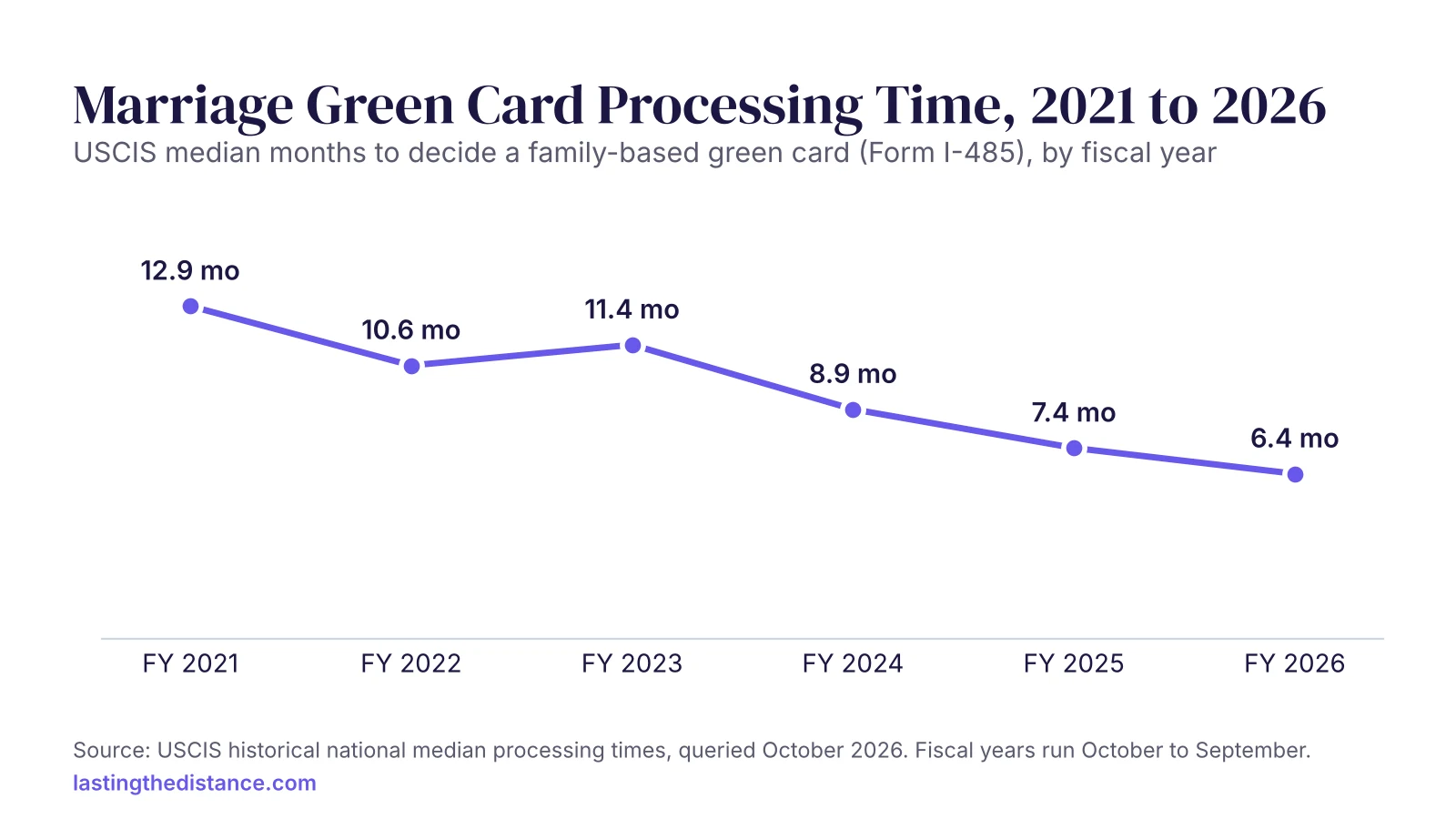
USCIS national medians as of Oct 2026 and National Visa Center times as of 9 Nov 2026. Half of cases are faster, half slower. Sources: USCIS, NVC. Each step's wait, with the trend since 2021: visa processing times.
Got your dates? Now: what it costs, and who pays what.
Step 3: What It Costs, and How to Split It Fairly
After a K-1, the government fees start at $1,440. Filing the I-130 and I-485 together, they start at $2,065. Tick the optional permits you want, then split the total in a way that feels fair to both of you.
Fee calculator
The required fees are already ticked. Tick any optional permits you want and the total updates.
Showing fees for: change
Later, not in the total
Not included: medical exam, passports, police certificates, translations and travel. Clinics and agencies set those, not the government. Compare costs across every route.
Splitting It in a Way That Feels Fair
There's no right answer here. Some couples split it by what they earn, some go halves, and sometimes one of you covers more for now because that's what life allows: a job search, study, a currency that doesn't stretch far. You're in this together, and fair means you both feel okay about it, not that the numbers match.
For what it's worth, we went 50/50 on our visa. Once we'd converted our pay at the exchange rate, we earned about the same, so halves felt fair to both of us. If your incomes are further apart, splitting by income might feel fairer.
Add what you each earn in your own currency, or set your own split, and talk it through.
Fair split calculator
Enter what you each earn in your own currency, then choose By income, 50/50 or your own split.
US partner pays 50%
Spouse pays it allUS partner pays it all
Add both incomes to split by income. Until then, this shows 50/50.
US partner pays ()
Spouse pays ()
About (estimate)
We convert at Wise's mid-market rate for the day shown below. The amount you actually send can differ a little on the day, so treat this as a guide.Converted amounts are estimates using sample exchange rates.
Pool your visa fund with Wise
We used Wise to send money between Canada and Australia the whole time we were long distance, and we still use it now that we've closed the distance. It's what we'd pick again for a visa fund.
Wise converts at the mid-market rate (the one you see on Google) and shows its fee before you send. Banks often add a markup to the exchange rate on top of their transfer fee, so the same transfer can cost a lot more than it looks.
One of you opens an account, you each pay your share in from your own currency, and the money sits in one place until the fees are due. Your spouse's share is about .
Sending $1,000 from the US
| Provider | Fee | Exchange rate | Partner receives |
|---|---|---|---|
| Sage | |||
Your partner gets about more with Wise.
Ask your bank what your partner would receive for the same $1,000 and compare.
Figures come from Wise's comparison data. The bank's were collected from its own website on . How Wise compares providers. Wise is our affiliate partner.
Wise doesn't currently quote US dollar transfers to . Check with Wise before you plan around it.
Affiliate link: we may earn a small commission, at no cost to you.
One more money question before the paperwork: does the US partner earn enough to sponsor?
Step 4: Do You Earn Enough to Sponsor?
The US partner promises the government they can support their spouse. That promise is the Affidavit of Support (Form I-864), and it needs an income of at least 125% of the US poverty guideline. Count yourself, anyone you support, and your spouse.
Sponsor income check
Pick your household size and where you live, then enter the sponsor's income.
Minimum for your household:
2026 guidelines, in effect from 1 Mar 2026. Source: USCIS Form I-864P.
Want the full 2026 table, or short of the minimum? Our I-864 poverty guidelines guide covers household size, assets and joint sponsors. Numbers sorted? Time for the paperwork.
Step 5: Your Green Card Document Checklist
Here's what USCIS asks for up front. Sending it all in the first package can avoid a request for more evidence later. Tick things off as you go, or print it.
Green card document checklist: 0 of done
Tick each document off as you get it, or print the list to share with your partner.
Source: USCIS, Checklist of Required Initial Evidence for Form I-485. USCIS may ask for more.
All in hand? Send your plan to your partner so you're both working from the same list.
Send Your Plan to Your Partner
We'll email you everything you've filled in above, with your numbers in place. Missed a section? Head back up and fill it in first. Not sure about something? Leave it as it is and talk it through together. Then forward it to your partner so you're both working from the same plan on your next call.
Before You File: Things That Catch Couples Out
- Send the I-693 medical exam with the I-485. Leaving it out can get the whole application rejected. USCIS Form I-485
- Sending every required document up front can avoid a Request for Evidence and the delay that comes with it. USCIS Form I-485
- Leaving the US while the I-485 is pending, without advance parole, usually means USCIS treats the application as abandoned. Plan trips home around the travel permit. USCIS travel documents
Couples Going Through This
You're not the only ones refreshing the case status page at 2am. These communities share timelines and answer the small questions.
- r/USCIS: couples comparing green card case updates and interview notices.
- r/immigration: the big general US immigration subreddit, good for odd questions.
- VisaJourney: the long-running forum where couples post their timelines and reviews of each embassy's interview day.
Not sure this is your route? Compare it with the K-1 fiancé visa, the CR-1 spouse visa et le F2A spouse visa, or start from all visa routes.
Form by Form Guides
Each form and notice on this route has its own guide, in the order you'll meet them:
- I-130A: the spouse supplement to the I-130
- NOA1 and NOA2 notices: what the I-797 letters mean
- Proof of relationship: what counts as evidence
- I-864 affidavit of support: income, the I-864A and joint sponsors
- Medical exam: Form I-693 and the panel physician
- Interview questions: what to expect, and how to practice
- Conditional vs 10-year green card: the 2-year rule explained
- I-751: removing conditions on a 2-year green card
- Citizenship through marriage: the 3-year rule for spouses
Marriage Green Card FAQ
Often, yes: if you're a US citizen and your spouse was lawfully admitted, they can usually apply for the green card from inside the US, which is what this guide covers. The visa matters for one thing: the E-3 (for Australians) and the TN (for Canadians and Mexicans) are for people who plan to leave at the end of their stay (State Department, TN rules), so if you marry and file soon after arriving, expect questions about when you decided to stay. The H-1B is different: its rules let H-1B workers seek a green card while keeping their status. Anything unusual about your case? Talk to an immigration lawyer first.
A spouse of a US citizen who is in the US and was inspected and admitted or paroled, or a K-1 entrant who married the US citizen who petitioned for them.
The 2026 national median for a family-based I-485 is 6.4 months. Your field office may be faster or slower.
After a K-1 it is $1,440 for the I-485. Filing the I-130 and I-485 together it is $2,065. Work and travel permits are optional extras.
No. If you married the US citizen who petitioned for you, the approved I-129F is the basis for the green card application.
Only with advance parole (Form I-131). Leaving without it usually means the green card application is treated as abandoned.
Spotted Something Newer?
Rules and fees change, and couples going through it often notice first. If something here is out of date, or you've been charged a fee we haven't listed, let us know. We check every report against the official page before changing anything.
This isn't legal advice. We're a long distance couple, not lawyers. Every fact here comes from official pages, but your case may have details that change things. For advice on your situation, find an immigration lawyer through the AILA lawyer search.
Sources
- USCIS Fee Schedule (G-1055), edition 10/26/26.
- USCIS, Checklist of Required Initial Evidence for Form I-485.
- USCIS Form I-485.
- USCIS, Travel documents.
- USCIS, I-864P poverty guidelines (from 1 Mar 2026).
- USCIS historical processing times et NVC timeframes (9 Nov 2026).

Transform your date nights
150 thought provoking questions and prompts designed for long distance couples.
Therapist approved, and made to play over video call or in person.
- Connect on a deeper, more intimate level
- Improve communication & understanding
- Learn something new each time you play
Loved by long distance couples
4.97
★★★★★
33 verified reviews
30-day guarantee
Hassle-free returns
Free US shipping
On orders $65+
Award winner
Announcement soon!
★★★★★
"The questions are intentional and thought provoking. I’m a psychotherapist and this one definitely has my stamp of approval."
★★★★★
"One card had us talking for an hour! Some of these questions got real emotional while others had us laughing!"
★★★★★
"The cards have helped us have every FT call be a deepening of our relationship. These cards have brought us closer and kept us close."
